All my new stuff's here: ian's eco blog 2006 - 2016... bringing together eco work and therapy work, Earthcare and Peoplecare.
Also new in 2016, a blog-within-a-blog about our home in the woods, "The LogCabavan Way"
I hope you enjoy reading about our adventures, all the best wherever you are!

Wednesday, July 16, 2014

Wednesday, December 04, 2013

Saturday, October 19, 2013

Thursday, September 26, 2013
New Blog: Ian Watt Therapy and Ecology
I've set up a new blog, Ian Watt Therapy and Ecology where I'll be posting up all my eco news along with stuff about my therapy and healing work, bringing the two worlds together just as I've been talking about for years... so do please check that out, I will make sure I have my head in the clouds and feet on the ground as much as possible. Here's the link again: Ian Watt Therapy and Ecology
There's so much the two worlds can learn from each other. Therapists generally focus on treating their patients, they might include their patients' relationships with other people in sessions, but how can healing not include a patient's relationship with the environment, the Earth and all life? And permaculture, sustainable living and other eco-projects most often seem to fail because of personality clashes, where people don't understand the dynamics of their behaviour and interactions with other people in their patterns and roles, where some deep therapy could really help. So that's what the new blog is all about, bringing the worlds of therapy and ecology together.
There's so much the two worlds can learn from each other. Therapists generally focus on treating their patients, they might include their patients' relationships with other people in sessions, but how can healing not include a patient's relationship with the environment, the Earth and all life? And permaculture, sustainable living and other eco-projects most often seem to fail because of personality clashes, where people don't understand the dynamics of their behaviour and interactions with other people in their patterns and roles, where some deep therapy could really help. So that's what the new blog is all about, bringing the worlds of therapy and ecology together.
Sunday, June 09, 2013
Nice weather at last...
We're appreciating the fine weather so much after all the rain last year and the long cold winter. It's such a pleasure to be living out here at the moment with the peace and quiet - save for bird song and bursts of tractor activity - with so much wild woodland about it feels like being right in the middle a forest. It's brilliant to be making progress with all the things I wanted to be involved with, living a simpler life closer to the Earth and having so much going on in the therapy/healing world too.
 |
| I heard the strangest honking bird song the other morning and thought it must be a swan but no, it was the Great Honk Bird |
 |
| Wonderful blossom this year |
 |
| We have the beginnings of a garden here and have been doing more on the outside of the caravan. We're determined to have a much more cosy winter than last one. |
 |
| Ruth has lots of brilliant salads growing at the moment... |
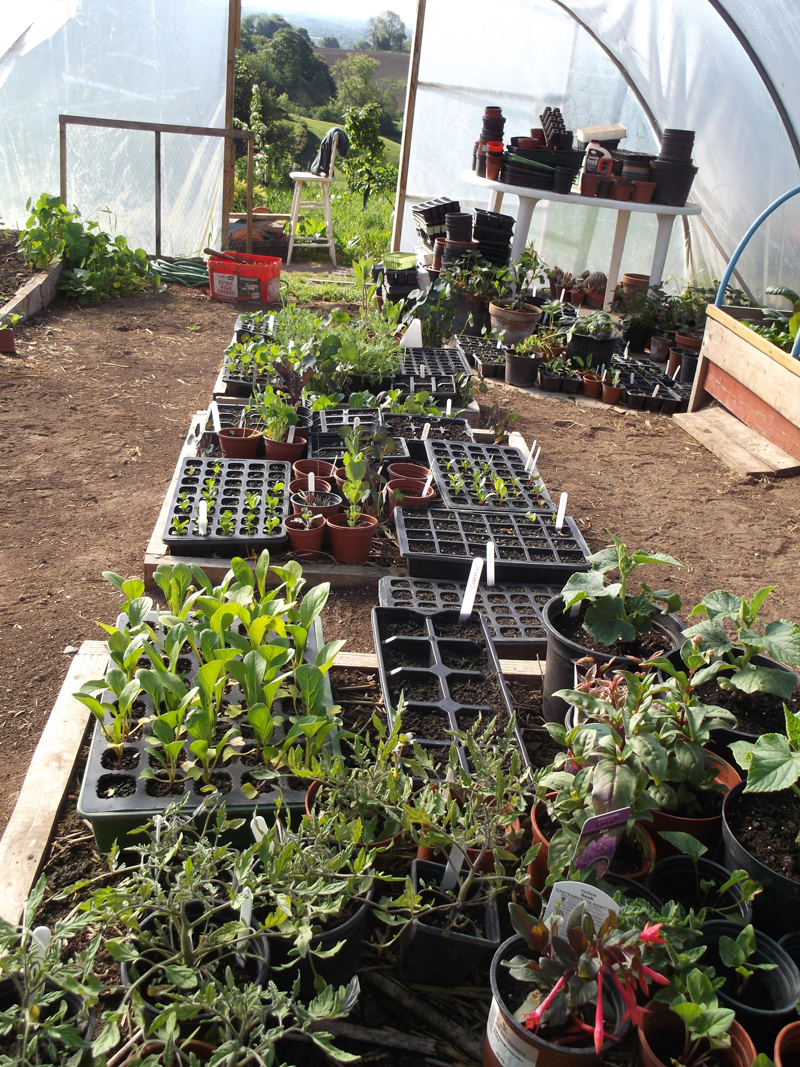 |
| ...and loads more stuff ready to plant out. |
 |
| And lovely to have Faze with us on the farm helping out with anything and everything in between gong sessions |
Saturday, May 18, 2013
Energy Medicine and Healing Work - going up a level - my new energy work blog

HOW CAN ENERGY MEDICINE AND HEALING WORK HELP US?
- Through a significant boost to world health - so many people receive little or no healthcare of any kind - the network of healing energy is a good start and can be surprisingly helpful for many people, and it's free.
- As part of living sustainably - Energy Medicine needs little or no equipment or electricity and, in the case of distant sessions, you don't even have to travel for treatment. Surely the more we can help people in this simple, low-impact way the better.
- By raising our awareness of and respect for each other: The world's problems are mostly people problems - the more we understand ourselves, what motivates us and helps us to work together the better.
IAN'S ENERGY WORK BLOG
Busy times...
So much happening here at the moment... This is Azzi who is building the new straw bale toilet and shower block with us. It's been designed with a timber frame as, wonderful as straw is as an insulator, it's not load bearing so you still need a frame of some kind to hold the roof, doors, windows and everything else together. It's been great fun working with Azzi who is a kindred spirit and fellow rebel against all the stupidity of the consumerist, corpocratic nonsense we find ourselves in. He's built himself a beautiful house at Sychpwll using straw bales with a frame of poles in the round and mostly reclaimed materials, all for less than £3,000. We were going to be holding a straw bale building course this weekend but it's been postponed because of the weather. I do hope that we don't have another wet year like 2012...
Up until the last week or so the weather has been wonderful here, warm and sunny, so good after the long cold, wet, muddy, challenging winter. One big plus of living and working out in the sticks is that we're getting more and more in tune with the landscape around us, and noticing the day to day changes in the trees and flowers. There's continuous bird song too from about 4.30 am. I couldn't begin to tell you what all the birds are, yet more ancient lore to re-learn.
Ruth and I have taken over part of one of the fields for more veg growing for food for all of us on the farm, for ingredients for the farm's pie business and to help feed the pigs. It's a bigger step than it might seem, taking land that a few years ago would generally have been ploughed and cropped in modern agribiz style and starting to treat it in a permaculture, sustainable way.
 Finally the yurt - it's about five years since I started making it back down in Brighton and it's mostly been stored away either at Lammas or in the barn here, so it's brilliant to see it up at last nestling amongst the trees. Having the extra space means we can at last start sorting out our stuff and begin work on getting the caravan ready for next winter, Ruth and I are determined to be better prepared this time.
 |
| Azzi on the frame for the straw bale toilet block |
 |
| Lovely to see the blossom coming out in the orchard |
 |
| Ruth planting tatties in a corner of the pig field - a big first step |
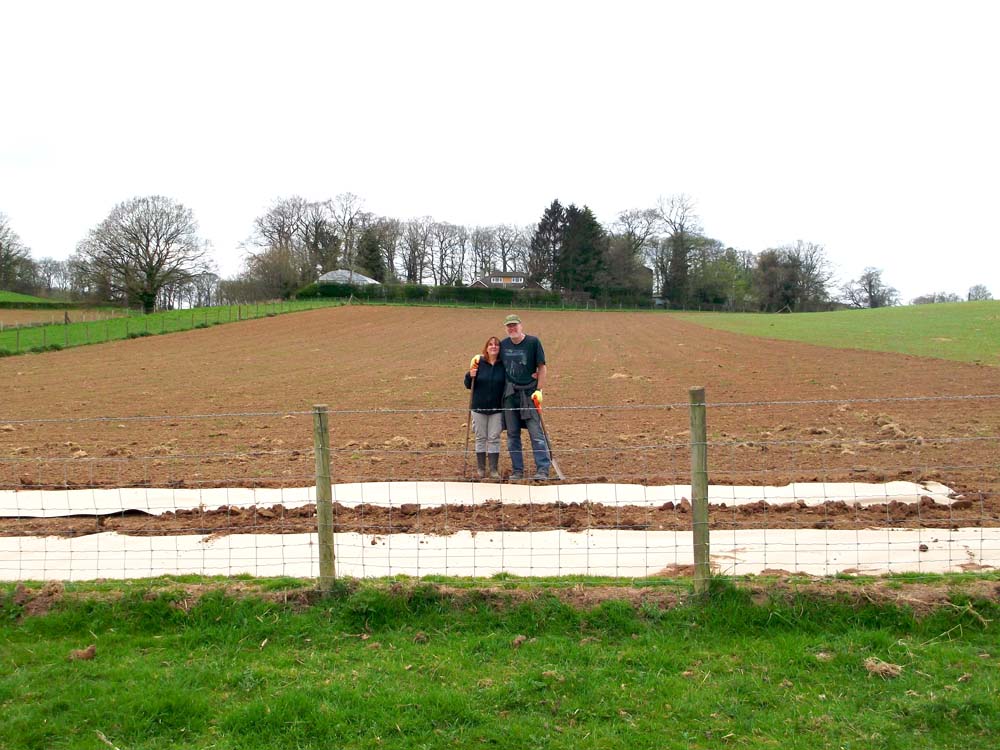 |
| Starting some no dig operations in the same field |
 |
| The rest of the field has been ploughed up and sown with barley to feed the pigs - our transitional corner is to the left of the photo in the same field |

Sunday, March 03, 2013
DEVELOPING THE PIG FIELD - INTEGRATED FOREST FARMING...
 |
| Prototype pig feeder bed - sleepers and angle-iron |
Lots going on here at the moment, including our plans to develop the pig field for food for the pigs and for the Treflach Farm pie business. The pig field is about three acres and we are thinking in terms of four strips for veg: beans, tatties, turnips and leeks. The plan is to keep the pigs off the veg to begin with using electric fence then let them onto what’s left of the veg strips at the end of the season so they can routle up the ground ready for next season. As well as that, we are planning some pig feeder beds which will effectively be mini-forest gardens with fruit or nut trees and perennial planting so that the pigs can either eat whatever falls on the ground or grows out through the gaps. Everything has to be pretty robust to survive pig assault so we will use up a stock of old sleepers for the beds.
 |
| They need to stand up to the scratchings of enormous boars and sows too |
Watching life here on the farm over the last year, I’ve realised how the animals are an important part of the whole system. For example, the woodland that's grazed some of the time is more diverse and also pleasant than the woodland that isn't grazed nearby. The more their behaviour can be controlled, integrated and utilised within the farm the less energy and expense required. The key idea being that the forest is a sustainable system and that a few carefully controlled animals fit into that very well. The more the whole farm develops in the pattern of the forest, the more the farm becomes sustainable ie: no waste, reduced inputs, increased diversity, increased types and quantities of yields, drought/flood/pest resistance, with space for paths, clearings and human settlement.
 |
| The pig field, about three acres of some of the best land on the farm |
Sunday, January 13, 2013
Whats life like in the eco world?
Muddy! What a wet year its been...
We're moving slowly towards a low-impact, sustainable way of life here. Sometimes progress seems to be really slow but I reckon we've at least taken the first big step, getting access to land.
EARTH WEALTH It's interesting that in Europe there's so many protests against government cuts while in India people have been marching for land. To me there's no hope that governments or any other of our rotten institutions will make things radically better. It's up to individuals to think for themselves, read, talk and do what they can locally to develop true wealth, ie Earth Wealth, for which you need access to land. Access to land means you can start growing food, fuel, materials, medicinal herbs and means that you can start dealing with your waste... it's not really waste after all. You don't even need to own that land, there's plenty of arrangements where you can swap your work for land access, and great stuff is being done on wasteland and with guerilla gardening. So to me the India land marches are more enlightened, more positive, and show people taking responsibility for world problems themselves.
WASTE This is where we've made most progress, it's easy to make a composting loo, you get a valuable resource after a year or so and save loads of water. Food leftovers, peelings etc go to the chicks, pigs or more compost. Although we get some of our milk, veg, eggs and meat from the farm we still get the bulk of our food from the supermarket, it takes years to get a garden going properly - which is why I'd urge anyone to get involved in food growing any way they can so that as and when there is a major collapse of the Oil Age way of life we're not caught totally unprepared - Powys only produces between 5 and 10% of the food it consumes, how about London? Looking at the waste we produce has made me realise how the packaging problem has just got worse and worse, everything you buy is packaged at least once, and it starts right on the farm with those big black plastic wrapped bales.
KEEPING WARM We have a colossal wood-burning stove and burn logs mostly from trees that have come down on the farm but there's fuel used for the chainsaws and tractor powered log splitter. We still use a couple of electric heaters and a de-humidifier to keep the caravan warm. There's a plan to plant up some trees on the farm for coppicing but again that will take time to produce anything. Slow burning logs produce a lot of toxins so I'm hoping we can adapt the stove to burn much hotter, small section coppiced wood being ideal for that. I've slowly been insulating the outside, photos below, and that's another point - if you're going to live out in a field, be prepared. "Any fool can be uncomfortable", an old army expression of my dad's. The difference between living in a van or whatever with no preparation and one that's properly insulated is huge. Cold and damp are not good for your health.
Ah well, lots to do, but the greatest journey begins with a single step...
We're moving slowly towards a low-impact, sustainable way of life here. Sometimes progress seems to be really slow but I reckon we've at least taken the first big step, getting access to land.
EARTH WEALTH It's interesting that in Europe there's so many protests against government cuts while in India people have been marching for land. To me there's no hope that governments or any other of our rotten institutions will make things radically better. It's up to individuals to think for themselves, read, talk and do what they can locally to develop true wealth, ie Earth Wealth, for which you need access to land. Access to land means you can start growing food, fuel, materials, medicinal herbs and means that you can start dealing with your waste... it's not really waste after all. You don't even need to own that land, there's plenty of arrangements where you can swap your work for land access, and great stuff is being done on wasteland and with guerilla gardening. So to me the India land marches are more enlightened, more positive, and show people taking responsibility for world problems themselves.
WASTE This is where we've made most progress, it's easy to make a composting loo, you get a valuable resource after a year or so and save loads of water. Food leftovers, peelings etc go to the chicks, pigs or more compost. Although we get some of our milk, veg, eggs and meat from the farm we still get the bulk of our food from the supermarket, it takes years to get a garden going properly - which is why I'd urge anyone to get involved in food growing any way they can so that as and when there is a major collapse of the Oil Age way of life we're not caught totally unprepared - Powys only produces between 5 and 10% of the food it consumes, how about London? Looking at the waste we produce has made me realise how the packaging problem has just got worse and worse, everything you buy is packaged at least once, and it starts right on the farm with those big black plastic wrapped bales.
KEEPING WARM We have a colossal wood-burning stove and burn logs mostly from trees that have come down on the farm but there's fuel used for the chainsaws and tractor powered log splitter. We still use a couple of electric heaters and a de-humidifier to keep the caravan warm. There's a plan to plant up some trees on the farm for coppicing but again that will take time to produce anything. Slow burning logs produce a lot of toxins so I'm hoping we can adapt the stove to burn much hotter, small section coppiced wood being ideal for that. I've slowly been insulating the outside, photos below, and that's another point - if you're going to live out in a field, be prepared. "Any fool can be uncomfortable", an old army expression of my dad's. The difference between living in a van or whatever with no preparation and one that's properly insulated is huge. Cold and damp are not good for your health.
Ah well, lots to do, but the greatest journey begins with a single step...
Saturday, January 12, 2013
Random Wintry Stuff
 |
| Ethereal light on a frosty tree back in the last cold snap - about minus 6 here |
 | ||
| Home sweet home, warmed by Herman the colossal stove with a couple of electric heaters too along with a de-humidifier |
 | |
| You only fit double glazing once so fit the best, fit bubblewrap |
 |
| Mud mud mud... |
 |
| The little stream... |
 |
| ...that flooded the fields below us |
 |
| A typical farm job for me, new pig shed panels |
 |
| Dawn on the solstice |
Insulation
 |
| I've been insulating the caravan on the outside, 2"x 2" framing clad with salvaged larch boards from Ruth's old garden fence |
 |
| Filling the space with bubblewrap and plastic waste we've been saving in old milk cartons... |
 |
| .. or just loose, that's a bundle of inner wrappers from those big round bales you see everywhere - a kind of plastic string vest |
 | |
| I have to say I think it's looking rather good, sort of Log-Cab-Avan or something |
Wednesday, November 21, 2012
The Thursday Group - distant energy treatments

FEEDBACK PLEASE
Your feedback is very helpful to me in developing this work, please message me or post something on the FACEBOOK PAGE even if it's just a couple of words.
There's more about how to join in with the group, getting ready etc on a separate page HERE.
I like the balance of doing down-to-earth practical stuff as well as therapy/healing work. I think it was Upledger who recommended having "your head in the clouds but your feet on the ground" - sound advice I reckon.
Friday, October 19, 2012
Polytunnel, bio-dynamics, companion planting
POLYTUNNEL

We're really pleased with what we've achieved in the veg garden so far. There's been plenty of failures and difficulties but plenty of successes too, a good first year. Things that didn't do well were tatties, peas, mange tout, swiss chard and spinach amongst other things. Other UK growers we chat too have mostly found it a difficult year with the endless damp and we've had problems with eel worm or wire worm and also with rats and mice. The successes have been peppers, chile peppers, tomatoes, herbs, strawberries, onions, celery, leeks, courgettes, beans and sweetcorn. It's nice to remember that many of the plants started off life on Ruth's windowsill back down in College Road. Well done us!
 |
| Ruth's window-ledge nursery back in College Road |
 |
| Ruth's tomato-polyculture: companion planting of toms with basil and flowers mulched with straw - great idea, easy to maintain and very productive |
 |
| Chile peppers galore |
 |
| Volunteers Ian and Alan working on the final, middle row of beds in the tunnel with Wes and I "helping" |
And if you're
at all inclined to try growing some stuff yourself but haven't started yet just
do it! I look back on all the mistakes I made back on my allotment and realise
now that it was all a great way to learn, your garden soon teaches you if
you're prepared to look and listen and it's really easy to research stuff via
the internet now - above all, the greatest journey begins with a single step...
BIO-DYNAMICS
 |
| Some of it might seem pretty wacky at first sight but the more you look into it the more it makes sense. The cow horn procedure boosts all-important bacterial soil activity |
Wednesday, October 17, 2012
Lovely fences and gates
I NEVER THOUGHT I COULD FEEL SO MUCH AFFECTION FOR FENCES AND GATES...
Our plot here has just been fenced off which is brilliant as now the cows can’t wander through it, trashing stuff and trampling the ground into a quagmire – it’s still very, very wet underfoot here, thick clayey goo that you can barely walk through. But now we can start channeling some of the water, doing some planting and carry on putting our low-impact ideas into practice.
Reading about the march of the landless people in India and about the poor harvest around the world has reminded me how lucky we are to have access to this plot. It’s about a third of an acre so a very useful size when taken as an addition to the farm’s orchard and veg garden.
DEALING WITH WASTE AND KEEPING WARM
We’ve made a good start all ready to dealing with the waste we produce and by getting a massive wood-burning stove fitted. It’s been really interesting to see just how much of different kinds of waste we do produce, plastic, metal, paper & cardboard, grey water from washing etc and of course the good old pee and poo. The real shocker is the plastic... I remember a book from the seventies, “The Waste Makers” by Vance Packard – we’ve been aware of the global waste problem for decades but it’s just got worse and worse since then. No doubt you’ve noticed how everything you buy is packaged at least once and no doubt you’ve read about the vast floating mass of plastic that has gathered in the North Pacific, reportedly the size of Texas. At the moment we’re using our own plastic waste for insulation by stuffing milk cartons with it and packing them beneath the caravan. I’m not quite sure what we do with the stuff after that but by then we’ll hopefully have reduced the amount of plastic we bring on here, reduction has got to be the general answer. Where does the plastic come from anyway?...largely from fossil fuel materials and fossil fuel energy. And there’s lots of other things to do with it like the plastic bottle greenhouse we made at Cwm Harry.
COMPOSTING TOILET
The first thing we did when we got onto the land was to fit the caravan with a composting toilet. It’s easy and simple, smells less than the old WC and will provide valuable compost for the heavy clay soil. In fact, the nitrogen in your pee is so useful in helping other things to breakdown that it seesm amazing that we ever flushed it down the drain. (Don’t worry if you’re visiting, it’ll be going into land for fruit bushes and small trees not for veg.)
KEEPING WARM
I had hoped to make a rocket stove thermal mass heater instead of the wood stove which would have burned the wood much hotter and without the toxins released from smouldering logs but we’re always short of time... feeble excuse, feeble excuse... Anyway, we’ll rig the stove, which is a monster, like something out of the Queen Mary, so that it burns hot and has plenty of thermal mass in and around it. Fuel for the stove comes from trees that have blown down on the farm, plenty of those so far - though we're using chainsaws and a tractor powered log splitter to harvest them... nothing's ever just totally simple is it?
 |
| Ha ha... cows' trampling thwarted by gate |
 |
| Gate equally beautiful from the opposite direction |
 |
| Lovely new gate leading from our plot into the orchard |
We’ve made a good start all ready to dealing with the waste we produce and by getting a massive wood-burning stove fitted. It’s been really interesting to see just how much of different kinds of waste we do produce, plastic, metal, paper & cardboard, grey water from washing etc and of course the good old pee and poo. The real shocker is the plastic... I remember a book from the seventies, “The Waste Makers” by Vance Packard – we’ve been aware of the global waste problem for decades but it’s just got worse and worse since then. No doubt you’ve noticed how everything you buy is packaged at least once and no doubt you’ve read about the vast floating mass of plastic that has gathered in the North Pacific, reportedly the size of Texas. At the moment we’re using our own plastic waste for insulation by stuffing milk cartons with it and packing them beneath the caravan. I’m not quite sure what we do with the stuff after that but by then we’ll hopefully have reduced the amount of plastic we bring on here, reduction has got to be the general answer. Where does the plastic come from anyway?...largely from fossil fuel materials and fossil fuel energy. And there’s lots of other things to do with it like the plastic bottle greenhouse we made at Cwm Harry.
COMPOSTING TOILET
The first thing we did when we got onto the land was to fit the caravan with a composting toilet. It’s easy and simple, smells less than the old WC and will provide valuable compost for the heavy clay soil. In fact, the nitrogen in your pee is so useful in helping other things to breakdown that it seesm amazing that we ever flushed it down the drain. (Don’t worry if you’re visiting, it’ll be going into land for fruit bushes and small trees not for veg.)
KEEPING WARM
I had hoped to make a rocket stove thermal mass heater instead of the wood stove which would have burned the wood much hotter and without the toxins released from smouldering logs but we’re always short of time... feeble excuse, feeble excuse... Anyway, we’ll rig the stove, which is a monster, like something out of the Queen Mary, so that it burns hot and has plenty of thermal mass in and around it. Fuel for the stove comes from trees that have blown down on the farm, plenty of those so far - though we're using chainsaws and a tractor powered log splitter to harvest them... nothing's ever just totally simple is it?
Friday, August 03, 2012
"Six Degrees" - four years on
 |
| A highly recommended read |
Wednesday, August 01, 2012
Greening the desert - amazing!
Monday, July 30, 2012
Weeding fields and orchard care
 |
| Wes, Ruth, Tom and Bob on the tractor weeding the meadows |
 |
| Ducks enjoying our work in the orchard |
 | ||
| Starting a bed for perennials around the base of one of the apple trees. |
This is an experiment we're trying, making a bed around the base of one of the apple trees for perennials starting with cardboard and horse manure. We plan to plant it up with herbs, maybe a small bush or two and also a climber, kiwi fruit perhaps, to build up diversity and yields and also to help to feed the tree. I'm wondering if this could apply to Janet and Clive's olives...
Friday, July 13, 2012
Courses and Events here at Treflach Farm
Lots happening here on the farm... I'm very excited to be teaching our first Forest Gardening course here, packing it full with talks, slideshows, film clips - including some jaw-dropping stuff on Forest Gardening's powerful application worldwide. Lots of hands on practise of the skills you need as well as observation of a wide variety of woodland here, from ancient Bluebell Wood to the orchard we are renovating. Not to be missed!
Also check out our ENERGY DAY - energy descent, solar, thermal, small scale hydro and an on site demo of anaerobic digestion by Methanogen AND our mini festival, FANDANGO FARM, if you've been rained off other festivals come here for family fun for all - hopefully in the dry!


Also check out our ENERGY DAY - energy descent, solar, thermal, small scale hydro and an on site demo of anaerobic digestion by Methanogen AND our mini festival, FANDANGO FARM, if you've been rained off other festivals come here for family fun for all - hopefully in the dry!

FULL DETAILS & BOOKING FOR FOREST GARDENING - CLICK HERE

FULL DETAILS & BOOKING FOR ENERGY DAY - CLICK HERE

FULL DETAILS & BOOKING FOR FANDANGO FARM - CLICK HERE
Subscribe to:
Posts (Atom)