Showing posts with label Permaculture. Show all posts

Saturday, May 18, 2013

Busy times...

So much happening here at the moment... This is Azzi who is building the new straw bale toilet and shower block with us. It's been designed with a timber frame as, wonderful as straw is as an insulator, it's not load bearing so you still need a frame of some kind to hold the roof, doors, windows and everything else together. It's been great fun working with Azzi who is a kindred spirit and fellow rebel against all the stupidity of the consumerist, corpocratic nonsense we find ourselves in. He's built himself a beautiful house at Sychpwll using straw bales with a frame of poles in the round and mostly reclaimed materials, all for less than £3,000. We were going to be holding a straw bale building course this weekend but it's been postponed because of the weather. I do hope that we don't have another wet year like 2012...
Azzi on the frame for the straw bale toilet block

Lovely to see the blossom coming out in the orchard
Up until the last week or so the weather has been wonderful here, warm and sunny, so good after the long cold, wet, muddy, challenging winter. One big plus of living and working out in the sticks is that we're getting more and more in tune with the landscape around us, and noticing the day to day changes in the trees and flowers.  There's continuous bird song too from about 4.30 am. I couldn't begin to tell you what all the birds are, yet more ancient lore to re-learn.

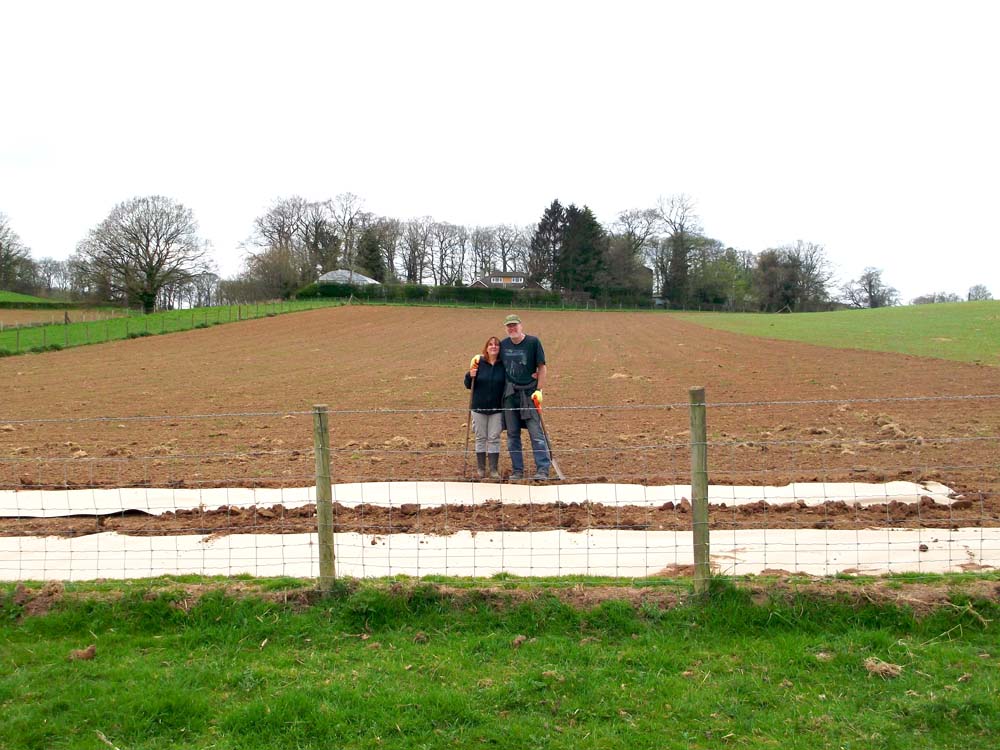
Ruth planting tatties in a corner of the pig field - a big first step
Ruth and I have taken over part of one of the fields for more veg growing for food for all of us on the farm, for ingredients for the farm's pie business and to help feed the pigs. It's a bigger step than it might seem, taking land that a few years ago would generally have been ploughed and cropped in modern agribiz style and starting to treat it in a permaculture, sustainable way.
Starting some no dig operations in the same field

The rest of the field has been ploughed up and sown with barley to feed the pigs - our transitional corner is to the left of the photo in the same field

Finally the yurt - it's about five years since I started making it back down in Brighton and it's mostly been stored away either at Lammas or in the barn here, so it's brilliant to see it up at last nestling amongst the trees. Having the extra space means we can at last start sorting out our stuff and begin work on getting the caravan ready for next winter, Ruth and I are determined to be better prepared this time.

Wednesday, August 01, 2012

Greening the desert - amazing!

This is a film that Steve Jones often shows on permaculture courses, it never fails to get a few jaws dropping. Geoff Lawton shows how Forest Gardening and permaculture principles were used to create lush vegetation in a dry, salty and very hot situation.

Sunday, May 20, 2012

Earth Sheltered Caravan - suggestions please!

EarthVan - warm air ducted from polytunnel/conservatory to heat sinks beneath caravan
We are hoping to get our caravan out of the barn here soon onto a patch of land beside the orchard. Then we are planning to use some of Mike Reynold's Earthship ideas amongst others to keep warm - it's the EarthVan. The ground will have to be levelled anyway so we thought we could do a bit more digging and make heat sinks to store warm air harvested from a polytunnel/conservatory/greenhouse structure to the front of the caravan.

HEAT SINKS, HELP PLEASE...
How big should we make the heat sinks? And what's the best material to use for them?  Rubble? Bottles? If anyone has any experience of anything like this any tips would be welcome.

FANS & DUCTS
Also, we are planning to use fans to duct the air from the top of the polytunnel section down into the heat sinks, powered by a PV panel - any tips on what specifications for the fans, panel and ducts would work best would be greatly appreciated.

THANK YOU!

Sunday, May 06, 2012

Orchard Renovation

 It's lovely to see the blossom coming out in the orchard and especially pleasing to see the tree in the middle of the picture below sprouting away happily as we gave it a radical prune in the winter and wondered if it would come away at all. Well done that tree!

Sunday, March 04, 2012

Permaculture Design Course, Treflach May 2012

We're hosting the fourth full two-week residential Permaculture Design course with Steve Jones and the Sector39 team here at the farm 13th to26th May. The Treflach PDC's have all been brilliant, spaces are limited though so check it out and book soon!

SECTOR39 HERE
STEVE'S BLOG HERE 

Tuesday, November 01, 2011

Permaculture Design at Treflach Oct 2011

This was Sector39's third Permacuture Design Course at Treflach and what a wonderful event it turned out to be. I felt I already knew everyone on the course when I met them - extraordinary feeling! Our team has been working together for a while now and the day's programme rolls along like well oiled machinery; Richie, Kev and Ruth and on the cooking, Steve, endlessly passionate teacher and knowledgeable on all aspects of sustainable living (difficult to get him to stop for meals sometime in fact...)
Steve also organises visits to interesting projects and people, while my role is to get the day started with  a Tai Chi/Chi Kung/Energy Work session in the mornings and to help out generally with anything that crops up from getting the compost loo "going" to treating a headache here and there. I also gave some lectures on the course on patterns in nature, people patterns and on design - this last one with reference to guitars, eg the Fender Telecaster, a fascinating tale and lovely to be able to share it. The course is after all a design course and studying how guitars have evolved shows brilliantly how the process works.
As well as all that, we had an ongoing Green Woodworking practical run by Richie and Kev and a teepee and two yurts on site, with music sessions late on into the night round a fire in the teepee. It's a packed programme alright.
Treflach is a family farm managed by Ian Steele and his parents, they are always tremendously welcoming and appreciative of any help we give. At the end of the day the course is all about our transition away from fossil fuels towards a life which respects and regenerates the Earth; it feels good to be part of that process and to see previous PDC students' ideas already being put into practice on the farm. I haven't processed any of my photos for ages but Ashley from the course has put a wonderful album together which you can see here: Ashley's photos - really worth a look, he takes photos from the heart and the album really captures the people and feel of the course.

Monday, October 31, 2011

A Permaculture year with Sector39

From November I'm moving on from Steve's flat in Llanrhaedr-Ym-Mochnant to live and work from Treflach Farm. I've had a fascinating time since August 2010 working with Steve helping to develop Permaculture courses and projects and learning all the time about Permaculture and sustainable living. Steve is exceptionally well informed and thoughtful, passionate about his work and has been a wonderful inspiration for me and the many students we have had on the courses and people we have worked with on projects such as the Cwm Harry community garden. I'm very keen to keep working with Steve, Sector39 is an excellent team now, the last course ran like clockwork and was a wonderful experience for me just as much as the students - one of them was kind enough to say that it was the best and most informative educational experience of his life. But it's becoming more and more important to me personally to adopt sustainable, low-impact living principles in my everyday life so I am moving to live and work from Treflach Farm, more about all that here.  Interesting that the world situation is heating up so much just as I make the move... will we tackle the real issues before they tackle us?

Raised Bed Season

It seems to have been Raised Bed Season recently - last time I was up in Scotland I helped a couple of my friends make beds for their gardens only to find that Steve had got an order for 800 beds when I got back down South. It's all been very interesting...
Steve Jones, Sector39 colleague Richie and I worked out a prototype for our customer, who was an enthusiastic student on a Sector39 Permaculture Design Course recently, "Steve! You're blowing my mind!" he is reported to have said. Using some guitar making knowhow, I made a jig to assemble the beds and then a team of us got together to complete the order. I found making the prototype and the jig really interesting but have to say the mass production side of the project just confirmed for me my intuition from way back in the 1970's that I want as little as possible to do with mass production... To me it has a de-humanising effect on people, tasks are broken down so that they take as little skill as possible, there's pressure to work as quickly as possible leading to pressure on quality and I have misgivings about all the transport we've got involved with. All the same they are really good, robust beds made from naturally weather-resistant larch and make the garden centre offerings look like so much junk. They're being sold as Radnor Raised Beds (site under construction) and will be well worth checking out if you're developing your food growing potential at home.
It is interesting that all of a sudden these different people have felt the need to start growing some food, I think they are at least partly responding to world change at a sub-conscious level, which is a nice lead to another post I'll be writing soon on the subject of Intuition.

Saturday, July 16, 2011

Anyone who wants power shouldn't have it

All the uproar in the media and the government at the moment just reminds me of a pack of ghastly spoiled children, all screaming, bullying and cheating each other behind their backs, and all the time our environmental systems, social systems, food production, world finances are creaking at the seams ready to burst. What chance is there that these people, in the pocket of big business, will ever do anything constructive about the dire state of our world? Exactly, fuck all.
Is it a case of wicked them and good little us though? I don't think so, there's only us, and we're all to blame for having these arseholes in control and for the mess we're in. So what to do? Here's some ideas:
GO LOCAL get involved with local people and projects, they're the people you're going to be working with in the future. Help to build up local skills, resources and resilience. Help to grow food locally - check out what we're doing at Cwm Harry. And come on a Sector39 Permaculture course! Our courses are all about local solutions for world problems.
GO FRUGAL cut down on your energy usage and other inputs - the less you need the more resilient you are. Learn how to use hand tools, buy as little as possible, get good quality stuff that lasts and can be repaired. I get so annoyed with the crap furniture for sale these days, chests of drawers that are barely able to hang together long enough to be taken to the skip - what a waste of energy, time and materials.
GO GLOBAL we're all connected, the choices we make and the stuff we're complicit with to keep us in oil and winter strawberries has an effect on people all over the world - read, think, talk about it.
...and above all, don't bother waiting for the bunch or arseholes we have in power to sort things out for you, they haven't a clue how to and they don't really have any control.

Tuesday, June 14, 2011

Roots-Up at CAT

Steve talking on Permaculture during the first Welsh Living Landscape Festival at CAT
A couple of pics of the new WISE building at CAT, the Centre for Alternative Technology in Machynlleth - Steve's talks there last month went really well and sparked off some interesting questions afterwards including: 
"Examples of roots up projects are all very well but will they ever become big enough to make a difference?"
But what's happening with the Facebook revolutions in the Middle East and North Africa if that's not a roots-up phenomenon? And of course CAT itself started in a disused slate qwuarry back in 1974...
Lots of interesting angle and shapes in CAT's WISE building. A lovely feel to the place thanks to the natural materials used, on the right the impressive rammed earth walls of the theatre.

SECTOR 39 - LATEST COURSE DATES inc the EDIBLE ROOF

24th September 2011 at the RISC roof garden, Reading. Learn about urban permaculture and designing your edible landscape in this stunning, well-established, food forest ON A CITY ROOF. More HERE and see poster below.
More about this amazing garden on the Sector39 blog


All 2011 dates:

JULY 2011
10th Forest Gardening at Treflach

SEPTEMBER 2011
10th, 11th Introduction to Permaculture, Hay Farm
16th, 17th, 18th Introduction to Permaculture and Edible Forest Gardening at Sych Pwll: £60
24th Forest Gardening day at RISC: £45

OCTOBER 2011
1st, 2nd W/E 1 Hereford PDC
8th to 22nd two week Permaculture Design Course at Treflach
29th 30th W/E 2 Hereford PDC

NOVEMBER 2011
26th 27th W/E 3 Hereford PDC
 MORE INFO AND BOOKINGS AT SECTOR39.co.uk


Tuesday, May 24, 2011

Permaculture Design at Treflach Farm May 2011

What a great bunch! I've met very few dread-locked hippy dope-heads in the Permaculture world, instead I've worked with some of the most intelligent, well-informed, caring, thoughtful people I've ever met with a broad range of practical and business experience. This course was no exception, great participants and also great people working on the various projects we visited during the course.

It's wonderful for me to be involved at the edge of exploring sustainability and I feel a sense of vindication, that it's my path. When I was living back down near Brighton I used to feel a continuous background unease, that living there was just shoring up the problems rather than looking actively for solutions.

I really enjoy working with Steve, apart from his breadth of knowledge and passion for permaculture he's always thinking about how to make the courses better and where best to put our energy generally. We included more ideas from my experience of the therapy world this time, there's a big overlap with permaculture ethics and principles. The healing journey is often a journey of inner understanding which mirrors and enhances the outward journey we are on towards regeneration of our environment and our partnership with the Earth.

There were two design briefs this time, one group worked on the project for a bunkhouse that Treflach's farmer, Ian Steele, will be building and on how to get more people involved with the farm. The other group looked at ways of developing the pigs' field into more diversity. They came up with excellent useful plans but more importantly they came to a deeper understanding of working with nature and working with each other. Well done you lot! good luck with all your projects and stay in touch.

I did these composite photos just for fun, individual photos are at:

Facebook PDC Treflach May 2011 Photo Album


Sunday, April 10, 2011

"The Biochar Solution" by Albert Bates

What an amazing book!
This is a really good read as well as being packed full of hopeful practical ideas and solutions for world problems. There's fascinating insights about soil, chemical agriculture, climate change, the sustainable abundant forest and carbon sequestration, all backed up with references to appropriate research papers.
Albert Bates details solutions that are already transforming lives on a small scale and may even have the potential to avert climate catastrophe. When carbon in the form of charcoal is locked up in the soil it can easily stay locked up there for a thousand years and in the soil its multi-micro-pocketed structure makes it a coral reef style habitat for the millions of micro-life forms that are found in healthy soil. Biochar is charcoal that has been impregnated with nitrogen, (you just have to soak it in pee) or bacterial or mycellial cultures and helps to bring back degraded soil.
The Amazon Carbon Store
Part of the book that made my jaw drop a bit deals with the Spanish conquest and eradication of the Amazon people of the 16th century. There may have been as many as 30 million people living in the area at the time and more than 99% of them may have been wiped out, mainly by mutations of the diseases of domesticated animals to which the Europeans were acclimatised - but to which the Native Americans had no immunity...
Jaw-dropping in itself, but the sudden growth of sapling trees afterwards, which incorporate carbon at the highest rate in the trees life, may well have led to the period of global cooling from 1500 to 1750 known as the Little Ice Age.
The Lucia Stove
This is just such a nice story! Nathaniel Mulcahy, an industrial designer of home appliances, injured his spine badly in a fall down a flight of stairs. His life was saved by his dog, Lucia, who supported his head and spine for over five hours until neighbours discovered them and summoned help. Once he had recovered, Mulcahy gave up his job and turned his skills to humanitarian engineering launching the company WorldStove. Their Lucia stove, named after his dog, is a brilliant design which runs on a wide range of biomass waste eg nut shells. The stove burns its fuel very efficiently and without the smoke which is a major health hazard for families who cook on open fires. The charcoal produced by the stove can be charged with compost and used as a soil-improver while also sequestrating carbon. Each time a Lucia stove is used to cook a meal for a family it can produce enough charcoal to filter 10 liters of water. WorldStove helps local communities to set up their own stove companies and the project is changing lives from Burkina Faso to Mongolia.

WorldStove's Lucia model.

Steve and I have both been really impressed with all the ideas and possibilities for biochar and will be doing some experiments with tin cans very soon - you can download plans for a simple stove/charcoal maker, the "EverythingNice Stove" from the WorldStove site.

"The Biochar Solution" is available from New Society Publishers at $17.95.

Friday, April 08, 2011

Florida calling....

I was delighted to get a request to write a guest article for my blog from a college graduate of the University of Central Florida, Krista Peterson. Krista is an aspiring writer and Health and Safety Advocate, she is passionate about the wellness of others in her community and for the health of the environment. She says she uses her writings to spread awareness of such issues to help encourage others everywhere to live the healthiest and most eco-friendly lifestyles possible. Brilliant! I think it's great that more and more people are waking up to the fact we are going to be forced to lead very different lives in the near future. Here's Krista's article:

Students at UCF are helping to develop an array of tools to make the solar panels that make up solar farms easier to install and monitor. UCF News Report,  "Greening the World's Energy" here.
A Primer on Permaculture
With the spring finally springing and the flowers blooming it’s getting to be a lovely time to be outdoors.  This spring, as you make your way outdoors be sure and take a moment to appreciate the beauty of your natural surroundings and consider that unless we make changes to be sure that we have sustainable development it may not be there much longer.  Of course making the change to permaculture and sustainable development is a serious and major commitment, but here are three easy ways to get started!

Eat Local and Organic
While it may be the way of the future, it’s not always possible right now for everyone to make the switch over to co-op farms, where rather than having factories produce food you purchase in supermarkets (yech!) a community bonds together to help raise livestock and plants in a natural, sustainable way.  But most people are able to support these growing sustainable farms by purchasing local organic food through a farmers market or local co-op. 
Garden and Compost
Of course, another great way to get your food locally is by starting your own garden! Starting a sustainable garden can save you a little green too, even up to $800 dollars a year in food costs. Growing a garden might seem daunting at first but sustainable gardening can be pretty easy, and is a great skill to learn.  And just in case you end up not needing as much food as you grow start you can start a compost!  Every eight months the UK produces enough waste to fill Lake Windermere.  If everyone simply dropped their food scraps, grass clippings, newspaper, cardboard, and coffee grounds into a compost we could dramatically lower the waste you leave behind. 
Natural Building
Natural building is a big part of permaculture because currently our building processes simply are not sustainable.  It can be a large undertaking, but building a house using primarily natural materials like logs seriously lessens your global impact and is likely to be a key facet in human housing in the future.  There are plenty of resources available if you’re up to the challenge of natural building, but if not you can always look into more natural modifications of your current home.  For instance, soy-based insulation foam is far more sustainable and healthier than other types of insulation, and can also protect you from mesothelioma cancer!
While a major culture change towards permaculture definitely ought to be in your plans for the future, these three easy steps can get you started down the path we all need to start walking. It’s time for us to turn away from unnatural, unhealthy manufacturing ways and start examining local natural solutions within our ecosystems.
 
Thanks Krista! Great stuff, I'm looking forward to reading your own blog once it's up and running. 

Monday, April 04, 2011

Final Weekend of Llandod Permaculture Design Course

What a journey this course has been! Instead of the usual two-week residential PDC Steve ran this course on a weekend-a-month format. This suited our course hosts, the Llandrindod Wells Transition Town Group much better - Steve will always adapt the course material to accommodate different groups' needs as far as possible.
Looking down to Nannerth Ganol through the beautiful old oaks on the hillside - I wonder how much human nonsense those old oaks have seen passing...?
Over the seven months we often said how much the Llandod course reminded us of The Council of the Elders from Lord of the Rings, partly because much of it was held at Nannerth Ganol, Roz and Brian's restored long house at the head of a beautiful valley. It was easy to feel a connection with the many generations of people who have lived there during the settlement's history - many, many thanks to Roz and Brian for all their hospitality, all the wonderful meals and for the use of their cottage. The course also had a Council of the Elders feel about it because although we had people of all ages, many of the participants have many years' experience from a wide range of working lives. It gives me a lot of hope that these respected, experienced, intelligent, connected people took the time to sit down together and study how we can work with nature to design truly sustainable lives and systems for the future - another big thank you to all the participants, it's been a wonderful experience getting to know you all. I'm looking forward to seeing how all the projects everyone is involved with flourish - not least the house whose re-design was central to the course, Lis and Nick's house, Trosnant.

 
Steve discussing garden plans with Lis and Nick, Trosnant in the background
Fully-fledged garden design above - the participants came up with excellent, detailed, integrated designs for the house, garden, energy and work systems, for Lis and Nick's contact with the community and with space deliberately kept free for "Wilderness Ideas" or inspiration from the bigger picture.
Unusual but very effective presentation idea from Alan - a box pasted up with permaculture ideas containing a wealth of local resources.
1: Scything Workshop, part of the final weekend. 2: Different blades for scrub and grass.  3: Removing bumps and twists from blade using mini-anvil or "peen". 4: Scything's a bit like Tai Chi...

Now we're getting ready for our next course, a return to Treflach Farm, 8th to 21st May, where it will be fascinating to see how Ian Steele is already incorporating some of the design ideas from our first course there back in October 2010. This is a unique opportunity to get right into the nuts and bolts of food production, energy systems, building bio-diversity, community access to land and much more - places still available - BOOK NOW !!

Friday, March 25, 2011

Traveling and Exploring - Great Resources

Matt Richards posted these links from his friend Tim Richard's Blog - great to see so much stuff going on:

Global Ecovillage Network – find one near you: http://gen.ecovillage.org/
    * Fellowship for Intentional Communities – find one near you: http://directory.ic.org/
    * Eurotopia – find an intentional community or ecovillage in Europe: http://www.eurotopia.de/
    * Worldwide Permaculture Network – the Facebook of Permaculture; find people and projects: http://www.permacultureglobal.com/

Friday, December 17, 2010

Everyday Life On the Edge...

A Permaculture Saying: "If you're not on the edge you're taking up too much space." 


We're on the edge here in Llanrhaeadr-ym-Mochnant alright! Geographically, we're very close to the border with England and also on the edge of the wilderness of the Berwyn mountains.The edge is a good place to be, it's where activity is often concentrated, whether its the edge of woodland, along the coastline or in our bodies through the membranes of the lungs, digestive system etc. In Llanrhaeadr-ym-Mochnant, you could say Steve and I are working at an edge, the one between modern day chemical agri-business and its sustainable successor, Permaculture.

Here in Powys we are surrounded by a beautiful, gently rolling landscape of small, sheep-spattered fields. The bad news is that those lovely fields produce just 2% of the food that is consumed in Powys and generally it costs more to shear those sheep than the wool is worth.Thankfully, the countryside is too hilly to have been put through the full-blown ravages of modern agriculture. It may be hard enough for farms here to make the transition away from oil but easier than it's going to be for some giant patch of the Shropshire plains, borrowed and leased for millions and mortgaged up to the hilt for decades ahead with just two or three people plying endlessly up and down the deserts on giant machines. It's difficult to see how they can make an easy transition to using one sixth of the energy they use at the moment (remembering that fertilisers and pesticides are just another form of energy as well).

The good news is that left to its own devices much of the land would soon revert to forest. (See the work of Chris Dixon.). The thoughtful, Permaculture approach is to work with that natural process and to steer it gently towards what you would like from the land. Instead of a high energy input, monoculture-desert, net loss landscape, the forest can be gardened to give us so much: food, fuel, materials, shelter, shade, water, energy, medicinal herbs, fodder crops for animals as well as fostering bio-diversity and being drought, disease and pest-resistant. And all the time building Earth capital instead of burning it up. (See earlier post about our Permaculture Design Course at Treflach Farm, farm in transition). We are teaching a two week Permaculture Design course again at Treflach from 8th to 21st May 2011, have our next Forest Gardening course on 22nd Jan 2011, and our first ever Treecare course covering pruning, planting and general woodland management is coming up on 5th & 6th Feb 2011. (More details and booking).

!! New Course !! Pruning & Basic Woodland Management for complete beginners onwards

We're really looking forward to working with progressive thinking Ian Steele at Treflach again.


And we are itching to get started on our own land-based project at PenY Garnedd where we will demonstrate all of this on our co-operatively owned 23 acre edge. Latest news is that the sale is going through.